
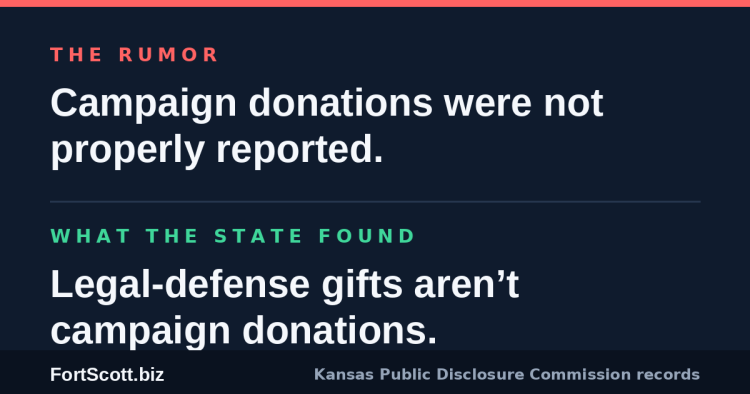
As Bourbon County Commissioner Mika Milburn-Kee fights criminal charges brought by the Kansas Attorney General, some residents have asked whether the money being donated to help pay her legal bills should it count as campaign contributions.
FortScott.biz filed an open-records request with the state agency that oversees campaign finance in Kansas, and the records show it took up that exact question earlier this year. An investigator for the agency told Milburn-Kee that money given specifically to cover her legal defense is not a campaign contribution as defined by the Kansas Campaign Finance Act, and does not have to be reported as one.
The situation stems from charges related to an Oct. 25, 2025 incident when the county commission room while it was being used for early-voting. For the full history, see State of Kansas vs. Mika Milburn-Kee and Judge Rejects Late Felony Charge; State Will Refile All Counts. Lawyers to defend against the charges costs money. As supporters discussed raising funds to help, questions circulated about whether those donations should have been reported as campaign contributions.
The records show that on April 13, Milburn-Kee emailed the agency herself “to request guidance regarding transparency and reporting requirements.” She asked whether “financial assistance for personal legal defense from family members or friends” is “subject to reporting requirements under Kansas ethics or campaign finance,” and said she wanted to “remain fully transparent and compliant with all legal and ethical obligations.”
Two days later, investigator Scott Smith responded with the agency’s written guidance:
“Funds donated or gifted to you for the purpose of paying for your legal defense of the criminal charges against you are not campaign contributions as defined by the Kansas Campaign Finance Act (CFA) and therefore do not need to be reported on any report required by the CFA.”
Smith added two points. First, Milburn-Kee cannot use her commissioner campaign contributions to pay for this defense. Second, he wrote that the donor’s intent for the money is what matters, and suggested she and anyone helping her raise funds make that purpose clear:
“It is the donator’s intent for the use of the funds that is key. Accordingly, I suggest that you, and anybody assisting you with raising funds for your legal defense, make it clear that you are not soliciting or accepting the funds as campaign contributions and that the funds will be used for your legal defense costs.”
The same guidance applies regardless of how the money is collected: “The foregoing applies to funds raised on the GoFundMe platform or by any other means.”
The agency is the Kansas Public Disclosure Commission (KPDC), formerly the Kansas Governmental Ethics Commission. It enforces the Kansas Campaign Finance Act along with state lobbying laws and conflict-of-interest and financial-disclosure laws for state-level officials. It is important to note that the KPDC oversees state-level campaign finance, not every ethics question about local officials. When a resident’s complaint about the fundraising reached the agency, it said so plainly:
“We do not enforce any ethics / conflicts of interest laws applicable to local political officers, including county commissioners. You may wish to consult with your county attorney or county counselor to determine if there are any local ethics / conflicts of interest laws that may be implicated.”
So the guidance answers the campaign-finance question she raised, but the commission was clear it does not decide whether any local county rule might apply.
The records also show the concern was formally raised when a resident sent a complaint about the fundraising to the Attorney General’s office, which forwarded it to the KPDC. Responding, investigator Smith gave the agency’s bottom line:
“Based on the information and allegations in your complaint, there is no apparent violation of any of the laws enforced by our office. However, if you have specific, verifiable information that may constitute a violation of the Kansas Campaign Finance Act, such as the commissioner using her campaign funds for her legal defense, then please let us know.”
The question behind the rumor was whether Milburn-Kee should have reported these donations as campaign contributions. Since the state says the donations for her defense are not campaign contributions, the Campaign Finance Act doesn’t specify any reporting requirement for them. However, that guidance only considers the relevance of Kansas campaign contributions laws. The commission specifically noted it does not decide any separate local ethics or legal questions regarding such donations.
FortScott.biz obtained these documents through a Kansas Open Records Act request. The commission released four responsive records and withheld one internal staff email chain under a KORA exemption for agency deliberations. The released records are posted in full below.
KPDC records on legal-defense donations for Commissioner Milburn-Kee (KORA response)
Related coverage
- State of Kansas vs. Mika Milburn-Kee
- Breaking: Kansas AG Moves to Add a Felony Charge Against Commissioner Milburn-Kee
- Judge Rejects Late Felony Charge Against Commissioner Milburn-Kee; State Will Refile All Counts
- Pretrial Hearing Friday in the Case Against Commissioner Milburn-Kee
Commissioner Milburn-Kee was contacted for comment but had not replied by the time this story was scheduled.