
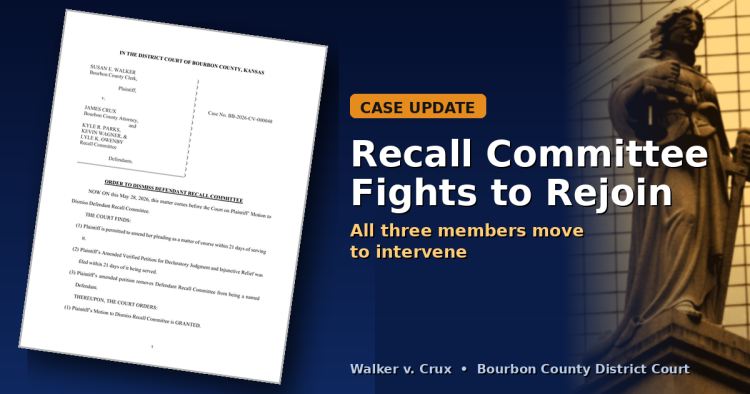
The legal fight over the effort to recall Bourbon County Clerk Susan Walker has taken a new turn: the three members of the recall committee, after being dropped from the lawsuit, are now asking the judge to let them back in as a group. On June 9 they filed a motion to intervene, along with a request to throw Walker’s lawsuit out entirely.
This is the latest step in a case we have been following. For the fuller background — how the lawsuit started and how the committee members came to be dismissed — see our earlier story: Walker v. Crux Update: Recall Committee Dismissed, Member Fights Back.
Key events
- A petition is being circulated to recall Walker from office. It points to mistakes on the USD 235 (Uniontown) school board ballots in the November 2025 election.
- Walker sued, asking a court to rule that the recall petition does not meet the legal requirements, which would stop it from going to a vote. She first named County Attorney James Crux and the three recall committee members as defendants: Kyle R. Parks, Kevin Wagner, and Lyle K. Owenby.
- She later narrowed her lawsuit to drop the three committee members and proceed only against Crux. The judge dismissed them from the case. Wagner then asked the judge to undo that dismissal.
What’s new (June 5–9)
- June 5 — Walker’s attorney filed a response opposing Wagner’s request to undo the dismissal. Her argument, in plain terms: dropping the committee members was proper, and if they want back in, the right way is to ask to “intervene” — formally join the case — not to reverse the dismissal.
- June 9 — That is exactly what they did. All three committee members, now represented by Wichita attorney Patrick B. Hughes, filed a motion to intervene under K.S.A. 60-224, the state law on joining a lawsuit. They argue they are “necessary parties” — people the case cannot fairly be decided without — under K.S.A. 60-219, because the case asks the court to decide whether their recall petition is valid. County Attorney Crux, they say, cannot stand in for them — his role is separate, and a ruling without them could leave Crux facing conflicting court orders later on.
- If the judge lets them back into the case, they also want to throw Walker’s lawsuit out under K.S.A. 60-5320, the Kansas Public Speech Protection Act, and to make Walker pay their attorney fees. That law — often called an “anti-SLAPP” law — lets people who are sued over protected speech or petition activity ask a court to dismiss the case early. They included a copy of that motion with their June 9 filing.
Underneath the legal back-and-forth is a factual dispute about what happened with the November 2025 ballots. Neither side disputes that about 50 of the USD 235 school board ballots used during early voting were printed wrong, but they do disagree about whether Walker acted fast enough to fix them.
The recall committee’s petition, which Kansas requires the petitioners swear are true, says Walker “caused to be printed and distributed incorrect ballots,” and that even though the problem was “brought to her attention by multiple individuals during the early voting period,” she did not correct it promptly and new, correct ballots were not printed until the night before Election Day.
However, in Walker’s sworn court petition, she says she “took immediate action to cure the ballot error”: within about four hours she and her staff set up a corrected election with the county’s voting-machine vendor, and, working into the early morning of Election Day, printed roughly 2,600 new ballots before voters went to the polls. In a written statement she released to the public, she added that her office received only one complaint just before early voting ended on Nov. 3, 2025 and that a review of two weeks of her office’s phone records turned up no earlier complaint. She points to the state law requiring that ballot mistakes be “corrected without delay” (K.S.A. 25-604) and says she did exactly that once she knew about the error.
It is worth being clear that none of these filings is asking the court to decide on the conflicting sworn statements. As the committee’s own filing puts it, whether Walker’s explanation is convincing is “a question for the voters, not the court.” The judge’s job at this stage is narrower: to decide whether the recall petition meets the legal requirements to move forward, such as stating valid grounds. Under K.S.A. 25-4302, “failure to perform duties prescribed by law” is one of the grounds Kansas law allows for a recall.
On June 9 the court also granted a 14-day extension giving County Attorney Crux until June 23 to formally respond to Walker’s lawsuit. The judge has not yet ruled on Wagner’s request to undo the dismissal, on the committee’s request to rejoin, or on the underlying question of whether the recall petition is legally sufficient. No hearing date had been set as of this writing.
Being named in a lawsuit is not a finding of wrongdoing, and the filings described here reflect each party’s arguments, not the court’s conclusions. FortScott.biz will continue to follow the case.