
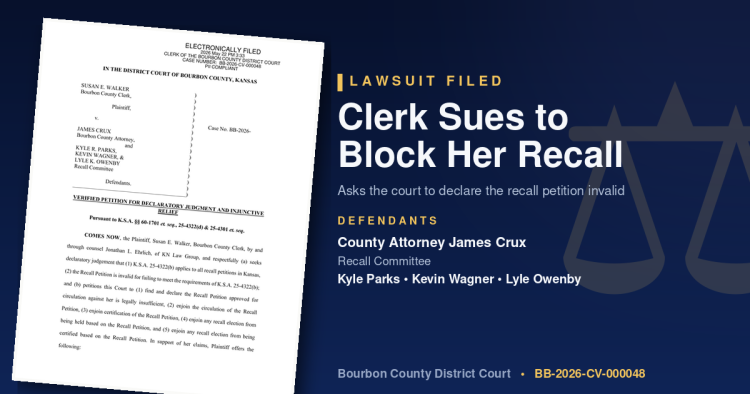
Fort Scott, Kansas — Bourbon County Clerk Susan Walker filed a lawsuit in Bourbon County District Court on May 22, 2026, asking a judge to stop the recall petition currently being circulated against her. The case, Walker v. Crux et al. (BB-2026-CV-000048), names Bourbon County Attorney James Crux and the three members of the recall committee — Kyle R. Parks, Kevin Wagner, and Lyle K. Owenby — as defendants. Hon. Richard M. Fisher Jr. is assigned to the case.
Walker also filed an emergency motion asking the court to halt signature-gathering immediately while the case is decided.
What Walker is arguing
Her 28-page lawsuit makes two main arguments:
- The county attorney never officially signed off on the version of the petition being circulated. Under K.S.A. 25-4322(b), the county attorney has to review any recall petition and notify the official, the recall committee, and the county election officer in writing before signatures can be collected. Walker says Crux did that for the first draft (see his letter on April 27, 2026) but not for the amended version.
- The reasons listed don’t legally qualify as grounds for a recall. Under K.S.A. 25-4302, a Kansas official can only be recalled for a felony conviction, “misconduct in office,” or “failure to perform duties prescribed by law.” Walker argues the petition is too vague to meet the standard Kansas courts have set in earlier recall cases.
What’s the recall about?
The recall traces back to an error on early-voting ballots for the November 4, 2025 general election. According to Walker, USD 235 (Uniontown school district) had not told the Clerk’s office which of three “voting plans” (A, B, or C, under K.S.A. 72-1083) it wanted to use for its school board race. The clerk’s office printed ballots under Plan C when the correct plan was Plan B. By the time the mistake was caught, 52 early voters had cast incorrect ballots. Walker laid out her account in a May 10 statement on FortScott.biz.
What both sides agree on
Both sides agree on the core error: the USD 235 early-voting ballots were wrong, and Walker’s office printed corrected ballots in time for Election Day. Walker’s lawsuit adds (and the recall side does’t dispute) that the election was then certified. No formal challenge was filed regarding the results of the election.
Where they disagree
When Walker found out — and how fast she responded. This is the heart of the recall. The previous no-confidence vote said the ballots were wrong “despite timely notifications from affected residents… while advance voting was actively underway,” and the recall petition echoes it almost word for word: the problem was “brought to her attention by multiple individuals during the early voting period.” Both imply Walker was aware of the issue and chose not to act for some time. Walker tells it differently. Her May 10 statement says the first notification was a call “before 12:00 PM on November 3” — the day before the election. Her lawsuit puts the first call at exactly 9:51 a.m. She says she began fixing the problem immediately, as K.S.A. 25-604(c) requires (“corrected without delay”). Neither the petition nor the no-confidence letter names dates, people, or specifies a timeline for the earlier complaints; Walker says she has a record of the November 3 call.
FortScott.biz contacted Bourbon County Republican party to see if they had any supporting information or evidence for the version of the timeline from the no confidence vote. The chairperson responded with this statement:
The issue that my precinct committeemen and women are focused on is that the wrong ballots were distributed.
(FortScott.biz also reached out to the households of Kyle R. Parks, Kevin Wagner, and Lyle K. Owenby via Facebook messenger asking if they had any information or evidence to support their statements in the recall petition that are disputed by the clerk. Mr. Owenby gave the query a thumbs up, but no other response was received before this article was published.)
Whether this legally counts as “failure to perform duties.” The petition says yes: Walker “caused to be printed and distributed incorrect ballots,” didn’t fix it quickly enough, and made statements “later contradicted by testimony from the school superintendent.” Walker says no: USD 235 failed to certify its voting plan, and she fixed the resulting ballot error as soon as she was notified they intended to use a different plan.
Whether the county attorney has signed off on the current petition. Walker says Crux’s April 27 letter only reviewed the first draft and that the amended version needs a new written determination. But that letter actually ruled on the two grounds separately finding “failure to perform duties” sufficient and “misconduct” insufficient. Crux told the committee, “Only the sufficient reasons for recall should be contained on the petition.” The amended petition does exactly that: it drops “misconduct” and keeps “failure to perform duties.” Whether Crux’s existing determination carries over as approval, or whether the amendment requires a fresh K.S.A. 25-4322(b) letter, is one of the questions for the court.
Whether the petition is specific enough. Kansas court rulings — Reynolds v. Figge, Baker v. Gibson, Unger v. Horn, and Cline v. Tittel — say a recall petition must state its grounds in 200 words or fewer (K.S.A. 25-4320) and specifically enough for the official to respond to (K.S.A. 25-4329). The recall petition’s key allegation reads: “The improper preparation, verification, and distribution of official ballots demonstrate a failure to perform the duties required of the office of County Clerk acting as County Election Officer under Chapter 25 of the Kansas Statutes.” Walker argues that allegation fails the specificity test. As her lawsuit explains on page 13:
“K.S.A. Chapter 25 includes forty-seven separate articles with hundreds of statutes containing thousands of subsections. Defendant Recall Committee must be more specific in its petition if they wish to allege violating a statute as grounds for recall. They could, for instance, cite to specific statutes as Defendant Crux did in his letter evaluating the first proposed recall petition. … There, Defendant Crux says, K.S.A. §§ 25-604(a) and 25-2303(a) are duties of the County Election Officer. Such specificity is nowhere in the Recall Petition, as it must be.”
In other words, Walker argues the petition must meet the same specificity standard Crux himself applied when he reviewed it.
Whether “misconduct” is still being alleged. The first draft used the word “misconduct.” Crux’s April 27 letter found “nothing in the petition supports this allegation.” The amended petition drops the word but keeps the same allegations. Walker says the misconduct claim is therefore still being made, just relabeled.
What this lawsuit does and doesn’t decide
According to K.S.A. 25-4325, the recall committee and people circulating the petition swear, under penalty of perjury, that the claims are true, but the claims do not have to be proven true in court for a recall to move forward. The law leaves the truth of the allegations to the voters. The only way to stop a recall petition in court is to show that it is legally invalid — not to show that its accusations are false.
That is the kind of challenge Walker has brought. She disputes several of the petition’s factual claims, but her lawsuit does not ask the court to decide whether they are true. It argues the petition is procedurally and legally insufficient: that the county attorney never issued the determination K.S.A. 25-4322(b) requires for the circulating version, and that its grounds are too vague and too disconnected from her actual duties. Kansas courts have drawn this line clearly. In Baker v. Gibson (1995), the Court of Appeals held that “the truth or falsity of the grounds must still be determined by the electorate, not the county or district attorney” — the very sentence Crux quoted in his April 27 letter, where he wrote that he reviewed the petition “assuming the facts are true,” not checking whether they were. Cline v. Tittel (1995) drew the same distinction, holding that the county or district attorney decides a petition’s legal sufficiency but “does not determine whether the grounds asserted should subject the local officer to recall.”
What the county attorney does decide is legal sufficiency: whether the petition alleges one of the three statutory grounds, states it specifically enough for the official to answer, and follows the required steps. If the court sides with Walker on any of those, it could block the petition without ever ruling on what she knew, when she knew it, or how fast she acted.
Timeline
- October–November 3, 2025 — Early voting underway. Walker says her first notification of the ballot problem came November 3; the recall side says residents notified her earlier.
- November 3–4, 2025 — Corrected ballots printed overnight; election held November 4.
- April 10, 2026 — Bourbon County GOP votes no confidence in Walker.
- April 22–27, 2026 — Recall committee files first draft of petition with Crux.
- April 27, 2026 — Crux issues his written determination: petition can proceed on “failure to perform duties,” not on “misconduct.”
- Early May 2026 — Recall committee files amended petition dropping “misconduct.”
- May 10, 2026 — FortScott.biz reports the amended petition has been filed; Walker issues her statement.
- May 22, 2026 — Walker files her lawsuit and emergency motion.
What Walker is asking for
She wants the court to declare the amended petition invalid and block signature-gathering, any recall election, and certification of any results. Her emergency motion, filed under K.S.A. 60-903, argues the ongoing recall is doing harm to her reputation that can’t be undone later. Walker is represented by Jonathan L. Ehrlich, Joshua A. Ney, and Wyatt Hoagland of KN Law Group in Olathe. No defense attorneys had appeared as of filing.
What happens next
Three things are in motion at once:
- The emergency motion. Judge Fisher can grant or deny it without first hearing from the defendants, but only if he finds Walker is being immediately harmed. This is the soonest milestone: if granted, signature collection stops while the case plays out; if denied, signatures keep being collected.
- The main lawsuit. The four defendants have been served and typically have 21 days to respond. Expect motions to dismiss and a hearing schedule over the coming weeks.
- The signature window. Under K.S.A. 25-4324, a recall committee has 90 days to gather the required signatures, and that clock starts when the committee receives the county attorney’s written notice that the grounds are sufficient. The only such notice in the record is Crux’s April 27 letter on the first petition, which would put the deadline on or about July 26, 2026. Walker’s lawsuit argues the amended petition now being circulated never received its own sufficiency notice, so when — or whether — a valid 90-day clock started is itself one of the disputed questions. Unless the court intervenes, signature-gathering continues.
Being named in a lawsuit is not a finding of wrongdoing; defendants may respond and contest the claims. FortScott.biz will continue to follow the case.