
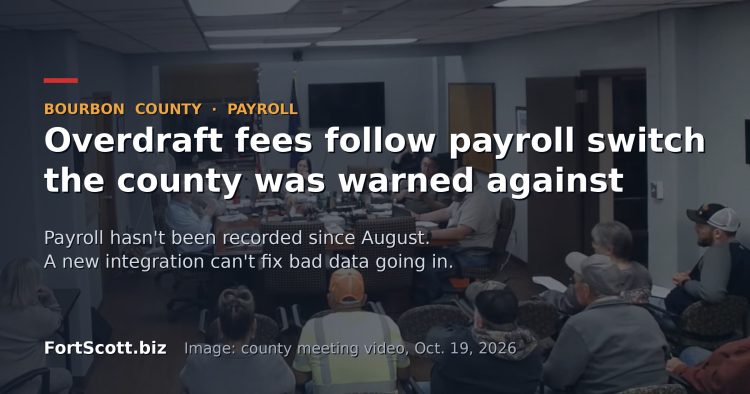
Bourbon County used to run its payroll inside CIC, the same program it uses to keep its books. In August 2025 the county commission voted to stop doing that and to pay Emerson & Company for access to its PayEntry software instead. Before the vote, the county clerk warned commissioners that PayEntry would not fit the county’s accounting system.
Fourteen months later, payroll is not being recorded in the county’s books. The county’s bank account has been overdrawn more than once, and taxpayer money has gone to pay overdraft fees.
On Oct. 26, County Treasurer Jennifer Hawkins told the commission that seven payrolls since Aug. 21 had not been recorded in the county’s books, and that the list of amounts that don’t match now fills “four pages.” The commission has now bought an integration that moves payroll into the accounting system automatically. Chairman Gregg Motley says that will not solve the problem.
This story uses meeting recordings, minutes and interviews to lay out what commissioners were told, what they decided and what has happened since.
Two problems, not one
When payroll ran in CIC, each payroll fed the books automatically. CIC “created what they called automatic invoicing from payroll,” Hawkins said in an interview Oct. 30, covering taxes, retirement and insurance. The old way was “definitely more efficient,” she said.
Now payroll is run in PayEntry, and the books are still kept in CIC. Every payroll dollar has to end up in CIC charged to the right department and fund, along with each deduction, such as KPERS, the state retirement plan, and employee health savings accounts.
The first problem is that the two programs did not talk to each other. After each payroll, someone in the clerk’s office had to type the totals into CIC by hand. The integration the county has now bought is meant to fix that part: PayEntry’s numbers can be imported into CIC instead of typed in.
The second problem is bigger. For payroll to land in the right places, PayEntry has to be set up with the county’s account codes, and each payroll has to be entered correctly. If the money isn’t assigned to the correct department and fund in PayEntry, the imported numbers will be wrong when they arrive in CIC. An import moves the data faster, but it moves the mistakes with it.
“The data is only as good as how it’s been input,” former County Clerk Susan Walker said in an interview Oct. 26.
What the commission was told
Commissioner Mika Milburn Kee brought the proposal to outsource payroll in July 2025. On July 21, Tim Emerson Jr. of Emerson & Company in Kansas City, Mo., presented PayEntry to the commission.
Walker, whose office kept the books, told him “it won’t integrate with our accounting software.” “Ours doesn’t receive imports, so it’ll have to be journal entries on our side,” she said, meaning the numbers would be typed in by hand. An import, she said, “would be an extra add-on that we would have to pay for.” She also asked “what kind of detail would we have when we receive that information.”
Emerson said his team “would actually look at your chart of accounts and structure that to where you could import it.” The chart of accounts is the county’s list of account codes.
Walker asked whether Emerson & Company would also check the county’s employee benefit bills. “We’d be happy to reconcile, but that’s not part of this engagement,” Emerson said. Walker said “that would be one thing that would be critical.”
On Aug. 11, the night of the vote, Walker told the commission, “I have to do a journal entry to get it posted to our general ledger.” Milburn Kee said, “This will take some of the work away,” and moved to hire Emerson & Company. Commissioner David Beerbower seconded. The minutes show Beerbower, Milburn Kee and Commissioner Samuel Tran voting yes. (Motley and Commissioner Joe Allen didn’t join the commission until the next year.)
An integration that was not bought
On Sept. 15, 2025, Walker asked the commission to sign a CIC contract for a file transfer, an integration that would let PayEntry’s numbers flow into the books instead of being typed in: $1,710, plus $1,000 a year. “If we don’t have the file transfer, then I have to journal entry every single entry,” she said.
“Let me make sure that this is the only way,” Milburn Kee said. “You don’t mind if I make sure that they don’t have another way?” Walker answered, “there’s no other way.”
No vote to sign the contract appears in the record. On Sept. 22, Walker told the commission, “We are not having a file transfer, so therefore I will have to be doing journal entries.” Emerson, on the phone that night, said, “we don’t need an integration. We don’t want an integration. Integrations are expensive.” He offered to “make the calls, and get back to you.” Milburn Kee said Walker would let CIC know that “Tim has full authorization of the commission.”
The meeting records reviewed for this story show no report that another way was found. Walker kept typing payroll into the books by hand until she left office. The county bought the integration 13 months later.
Wrong codes from the start
Problems with the setup showed up before the switch was finished. According to the October 2025 minutes, Hawkins raised “incorrect employee codes,” and Walker said the timeline was “premature, as not all programming components have been fully configured or tested.” On Oct. 27, 2025, Emerson told the commission, “these codes are not accurate in CIC.”
The commission’s executive assistant, Laura Krom, took over running payroll on Jan. 1, 2026. Walker kept recording it in the books.
On Feb. 9, Walker said that when employees are hired, “I am not given the information of what cost center they have to be,” meaning which department pays them. On May 11, she said the PayEntry report she received was “not broken down by cost center,” and “there’s new codes that are added, and there’s no explanation to why those codes are.”
That night Motley moved to give the clerk read-only access to PayEntry reports. “Pay entry does not integrate with our accounting system,” he said. “CIC did, our former payroll system.” The motion failed 2–3, with Milburn Kee, Tran and Beerbower voting no.
Tran has said some of the trouble came from the changeover itself. “A lot of it stems from us losing legacy information,” he said on Feb. 19, “because a lot of stuff that was supposed to migrate from 2025 into 2026 didn’t migrate. And that’s not a Pay Entry issue.”
Since the clerk left
Walker left the clerk’s office at the end of August. Before she left, Hawkins said, Walker “sent a large email to the commissioners letting them know these are all of the issues that I’ve been talking about all year that are still outstanding and need to be rectified.”
“The accounting record is CIC, not pay entry,” Walker said. Payroll can be run in PayEntry, she said, but “someone has to get that information in there. And no one has since I left.”
Hawkins said that because payroll is not being recorded, she gets no notice to move money to cover automatic payroll withdrawals, which is how the county’s account was overdrawn. “The issue is nobody is following through,” she said.
In an Oct. 28 email to commissioners, Hawkins wrote that the account was overdrawn “again” and that the county had been charged $262 in overdraft fees, the Bourbon County Monitor reported. Motley said automatic withdrawals for employee health insurance cause it: “Blue Cross Blue Shield, every time it hits, it overdraws us.”
On Oct. 19, Motley told the commission, “we have issues for 10 months now of incorrect accounting entries,” and, “we can’t wait until the audit where we’re going to get slaughtered.”
Milburn Kee then moved to buy the CIC integration. “They were looking for a solution, and I found one that was immediate,” she said, adding that the county’s CIC representative told her “there are many counties that use this import that have outside payroll.” She said the software “should have been implemented with the change.” The motion passed. Motley said fixing the backlog is not covered by the county’s contract with its accounting firm, Baker Tilly, “So they would charge us extra for fixing all this.”
Why the integration won’t fix the payroll
On Oct. 26, Hawkins said departments would have to go back through “the seven payrolls” by hand to see where their budgets stand. “There needs to be a lot of checks and balances. I can’t do everything,” she said.
Motley followed: “the CIC fix will not fix the payroll problems that we have.”
Walker and Hawkins said the same in interviews. Asked whether the trouble was getting reports out of PayEntry or getting information into it, Walker said, “Not putting stuff into Pay Entry correctly.” Hawkins said an automatic import “does not solve anything because if it doesn’t reconcile, we’re still going to have those issues.”
Where it stands
On Nov. 2, the commission approved a first payment of $780 for the CIC integration, half its $1,560 cost. Commissioners said it also carries a $1,200 yearly charge.
That night Matt Lawn of Baker Tilly told the commission by phone that the firm had brought in bank reconciliation specialists who “have got started on working out any outstanding items.” Asked whether the work was only payroll, he said, “It’s more than just payroll.” For now, he said, “we’re going to work off of our current contract with the county,” with a cost proposal to follow.
Milburn Kee said the county’s auditor had told her that “a lot of these things are journal entries and they should be made timely,” and some had not been.
Reached by phone Nov. 2 and asked whether she would answer questions about payroll, Krom said, “I’m going to decline them all.”
Milburn Kee, who made the motions to hire Emerson & Company and to buy the software, declined a phone interview, writing that “our county counselor does not like us giving press interviews.” Three other commissioners told FortScott.biz that the county counselor has not told them not to talk to the press. One said he might not encourage it, but that the decision is the commissioners’.
Milburn Kee wrote that she is speaking with Baker Tilly, the lawyers and the auditors “to get to the root so things can move forward smoothly.” She also questioned how the work was divided under the old setup, including whether the clerk was paid extra and whether the office was understaffed.
Tim Emerson Jr. did not return a message left Nov. 2.
Back in the clerk’s office
According to commissioners, Krom is now deputy county clerk under the new county clerk, Ann Clarkson. She still runs payroll. That means payroll is now run by someone who works in the clerk’s office, the office that keeps the county’s books. Krom may be doing payroll as the commission’s assistant and other work as deputy clerk, but it is the same person, and as deputy she works under the clerk.
That is what the commission’s own resolution was meant to prevent. In February, the commission unanimously adopted a resolution, read into the record by Tran and seconded by Milburn Kee, assigning payroll to the commission’s executive assistant. It said the county’s internal controls are maintained through “separation of payroll processing and financial posting functions.” In other words, running payroll and recording it in the books are required, by resolution, to be kept apart.
On April 20, Milburn Kee told the commission that payroll administration was no longer a function “of the clerk’s office but of the executive assistant as directed by this board.”
In February, Milburn Kee told FortScott.biz, “I am pleased with the separation of duties that we get with this change.” She also said, “It is reassuring to me that payroll will not be changed by the coming or going of the elected.”
The commission corrected a date on the resolution in May. The meeting records reviewed for this story show no vote to repeal it. With the person running payroll now in the clerk’s office, the county is back where it started and is violating its own resolution.
Asked by text Nov. 6 whether Krom running payroll violates the resolution, Milburn Kee did not answer the question.
What the chairman says
In an interview Oct. 30, Motley said the main trouble was not the software. Payroll “was done wrong on several occasions, especially the HSAs and the [KPERS],” he said, and “the amount that pay entry withdrew did not equal really what the math should have been.”
“We made mistakes. We made coding errors. We made calculation errors,” he said.
From January to August, he said, commissioners “would get 3, 4, 5, 6 emails from Susan saying, this is wrong, this is wrong, this is wrong” after each payroll. Walker worked backward from PayEntry’s reports to figure out where the money belonged, he said, and “the costs were hidden because Susan just worked overtime and just did it.” But when the deductions didn’t add up to what had been withdrawn, she could not tell which employee’s entry was wrong without payroll records she was not allowed to see. “She fixed everything she could,” he said.
Asked whether the setup was the problem, he said, “I don’t think any mapping was done,” then added, “I don’t even know.” He said Krom “had to go in and assign the account numbers off our charts of accounts. And sometimes those were right and sometimes they weren’t.” Asked whether Emerson & Company could be made to fix it, he said, “Emerson can’t fix it,” adding, “not that I’m aware of, but I wasn’t on the commission when those decisions were made.”
The integration “will not fix the problem,” he said, but once past payrolls are brought in, departments will have “95% understanding of where they are in their budget.” After that, he said, the treasurer will have to find what needs correcting and tell the clerk. Clarkson does not have PayEntry access either, he said.
Longer term, Motley said, he would like the clerk trained on CIC, a payroll clerk added and payroll moved back to the clerk. He would drop PayEntry. “Why would we pay for two systems?” he said.
He said Standard & Poor’s is already watching the county, and a bad audit this year could lower its credit rating and raise what it pays to borrow.
“Payroll is complicated, and it requires accounting expertise,” Motley said. “That’s what we lost when we lost Susan.”
Timeline
- July 21, 2025: Emerson presents PayEntry. Walker says it will not integrate with the county’s accounting software.
- Aug. 11, 2025: The commission votes to move payroll out of CIC and hire Emerson & Company.
- Sept. 15, 2025: Walker asks to sign a $1,710 CIC integration contract. Milburn Kee asks to look for another way. It is not bought.
- October 2025: Hawkins raises incorrect employee codes. Emerson says the codes are not accurate in CIC.
- Jan. 1, 2026: Krom takes over payroll. Walker keeps recording it in the books.
- Feb. 9, 2026: The commission unanimously adopts a resolution assigning payroll to its executive assistant and separating payroll from the books.
- May 11, 2026: Motley’s motion to give the clerk read-only PayEntry access fails 2–3.
- Aug. 31, 2026: Walker leaves office. Payroll stops being recorded in the books.
- Oct. 19, 2026: The commission approves buying the CIC integration.
- Oct. 26, 2026: Hawkins reports seven unrecorded payrolls. Motley says the integration will not fix the payroll problems.
- Oct. 28, 2026: Hawkins emails commissioners that the account is overdrawn again, with $262 in fees.
- Nov. 2, 2026: The commission approves the first $780 payment. Baker Tilly says its specialists have started on the backlog.