



What do we mean by eating “real food”?
Do you ever glance in someone’s grocery cart and see all processed, easy-to-warm-up box meals, chips, sodas, and such, and wonder how healthy they are? What does your own shopping cart look like? Do you buy ingredients to make meals? You may have seen in the news recently that the U.S. Department of Health and Human Services and Agriculture released their new dietary guidelines for the next five years.
These new guidelines place a heavy emphasis on eating real, whole foods and encourage individuals to increase the nutrient-dense foods they consume, while reducing heavily processed foods. The new guidelines do retain many of the previous recommendations, but it is important to understand the key differences between them. The hope is that these guidelines will help Americans make informed nutrition decisions for themselves and their families for the next five years.
Key Takeaways from the 2025-2030 Dietary Guidelines for Americans:
Build most meals around whole foods with limited ingredients.
- Consume a variety of protein foods from animal and plant sources.
- When cooking, focus on baking or grilling rather than deep-frying.
- Incorporate fiber rich foods such as beans, lentils, and other legumes.
- Avoid highly processed foods that contain many ingredients such as chips, cookies, candies, and sodas. When consuming processed foods, choose those with shorter ingredient lists.
- Pay attention to portion sizes, especially for foods higher in calories.
Eating real food means choosing foods with a few ingredients without added sugars, industrial oil, artificial flavors, or preservatives. Did you know there is such a thing as a “healthy fat”? Examples would include meat, seafood, dairy, nuts, olives, and avocados. It’s also recommended to avoid trans fat oils such as canola, and to use oils such as olive, avocado, peanut, or safflower oil.
Understanding changes in dietary guidelines can be overwhelming and confusing. Research is always happening, and we are continuing to learn more about foods and what they do for and to our bodies. The first step in taking charge of your health is becoming more informed. Focusing more on protein and vegetables can support muscle health, metabolic function, gut health, and stable energy while naturally phasing out of eating highly processed foods.
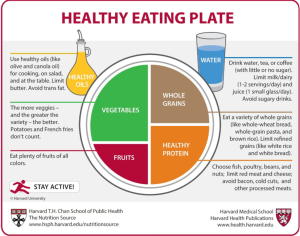
You may have heard of the MyPlate Eating Plan of one fourth each of the plate for vegetables, fruit, protein, and grains. This has been replaced by an “upside down pyramid” which recommends 3 servings of vegetables, 2 servings of fruit, 2-4 servings of whole grains, and 1.2-1.6 grams of protein per kilogram of body weight per day (approximately 5-7 ounces per day).
Instead of the MyPlate diagram of the past, the recommended visual is the Healthy Eating Plate from the Harvard T.H. Chan School of Public Health, which emphasizes consuming more protein and vegetables:

For more information, visit realfood.gov, or contact Sandy Haggard, Nutrition, Food Safety, and Health Agent, Southwind District at SJHaggard@ksu.edu or by calling 620.365.2242.